

Blog & News
How Much Does Custom Cosmetic Packaging Cost? A Transparent Breakdown
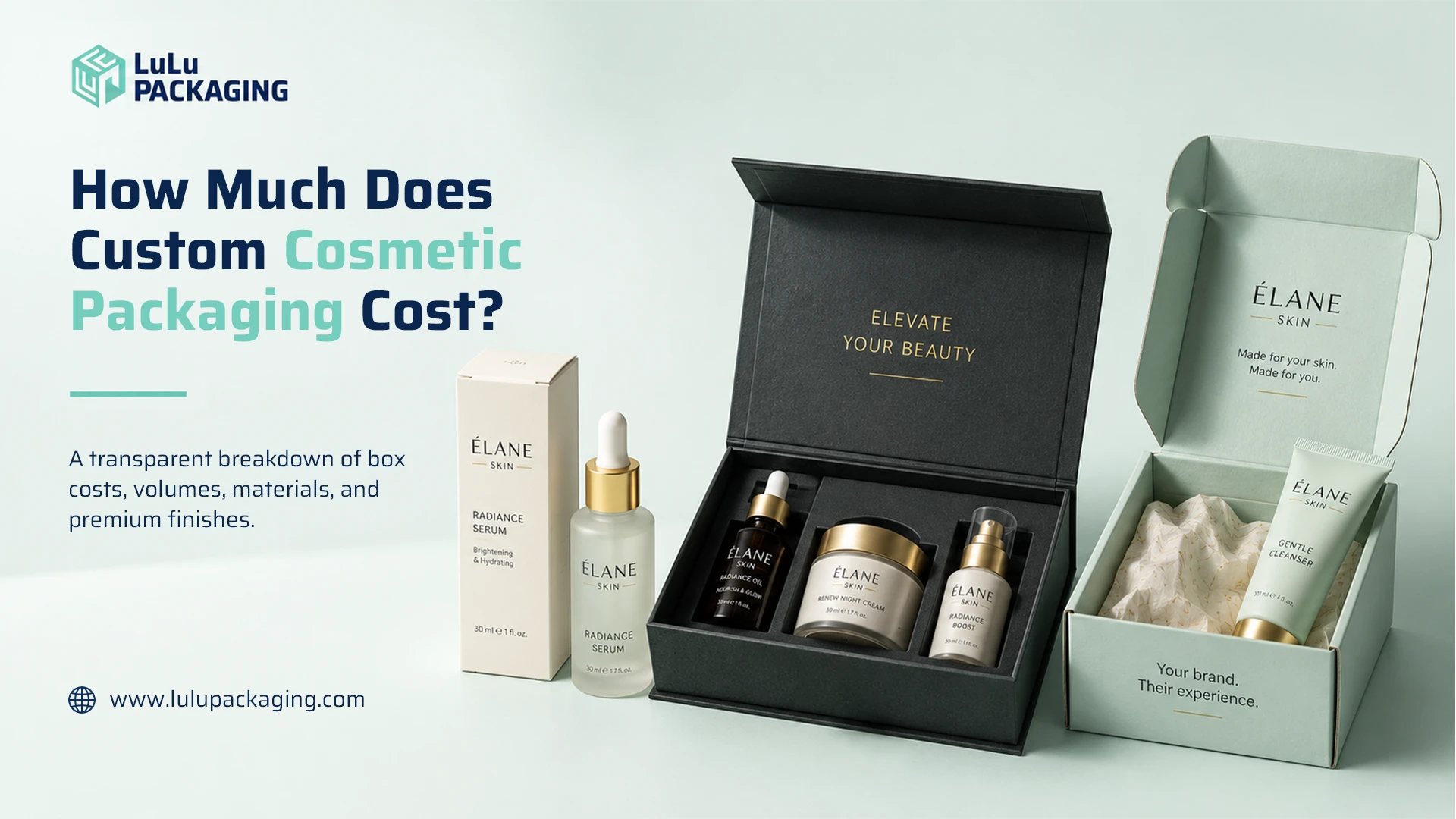
Most packaging suppliers will tell you "it depends" and leave you to figure out the rest.
We're not going to do that.
We talk to US cosmetic brand founders every week. Some are launching their first product. Others are scaling an existing line and trying to get their unit economics right before a retail pitch. And almost every one of them has the same frustration. They can't get a straight answer on what packaging actually costs.
That stops here.
This guide breaks down real pricing for custom cosmetic packaging in the USA, by box type, material, finish, and volume. We'll also walk you through the factors that move the number up or down, what to budget beyond the unit price, and one industry benchmark that most brands don't know to but should.
No vague ranges. No hidden variables. Just the numbers, explained clearly.
The Industry Benchmark You Need to Know First
Before we get into specific costs, here's a number that changes how you think about the whole question.
Industry data shows that packaging should account for 5 to 12 percent of the retail price of a beauty product. Under 5 percent typically means you are under-packaging, and under-packaging costs you sales. Over 15 percent means you are over-investing relative to your price point.
Here is what that looks like in practice:
| Retail Price | Recommended Packaging Budget (Per Unit) |
|---|---|
| $15 product | $0.75 to $1.80 per unit |
| $30 product | $1.50 to $3.60 per unit |
| $60 product | $3.00 to $7.20 per unit |
| $90 product | $4.50 to $10.80 per unit |
Use this as your anchor. Before you compare quotes, know what range your retail price supports. It stops you from over-specifying at a price point that won't carry the investment to and from under-specifying at a price point where the packaging is quietly costing you conversions.
Custom Cosmetic Packaging Cost by Box Type
Pricing varies significantly by structure. Here is a realistic breakdown based on current 2026 production data for US cosmetic brands.
Folding Cartons
Folding cartons are the most widely used structure in cosmetic packaging. They ship flat, assemble quickly, and print beautifully. They are the cost-efficient workhorse of the category.
2026 pricing by volume:
| Volume | Price Per Unit |
|---|---|
| 500 to 1,000 units | $1.20 to $2.80 |
| 1,000 to 3,000 units | $1.00 to $2.25 |
| 5,000 to 10,000 units | $0.45 to $1.50 |
| 10,000+ units | $0.30 to $0.90 |
These ranges cover standard custom printing with matte or gloss lamination. Premium finishes to soft-touch, foil, spot UV, embossing to are priced separately and added on top.
Best for: Mid-market to premium skincare, individual product units, brands managing multiple SKUs
Rigid Setup Boxes
Rigid boxes use thick greyboard wrapped in specialty paper. They do not fold flat. They are heavier, sturdier, and communicate premium quality before the customer opens them. They are also more labor-intensive to produce, which is reflected in the price.
2026 pricing by volume:
| Volume | Price Per Unit |
|---|---|
| 500 to 1,000 units | $4.00 to $12.00 |
| 1,000 to 3,000 units | $3.00 to $8.00 |
| 5,000+ units | $2.50 to $6.00 |
Luxury formats with magnetic closures, two-piece construction, or specialty paper wraps can reach $12.00 to $25.00 per unit at lower volumes.
A useful comparison: a soft-touch folding carton at $0.85 per unit delivers roughly 80 percent of the rigid box experience at around 30 percent of the cost. For brands at a $15 to $30 retail price point, that combination often makes more sense than a full rigid box.
Best for: Gift sets, hero products, premium skincare, fragrance, PR kits, limited edition collections
Mailer Boxes
Mailer boxes are designed to ship without an additional outer carton. For DTC e-commerce brands, this is the first physical touchpoint the customer has with the brand.
2026 pricing by volume:
| Volume | Price Per Unit |
|---|---|
| 100 to 500 units | $1.30 to $3.80 |
| 500 to 2,000 units | $1.00 to $2.50 |
| 5,000+ units | $0.60 to $1.40 |
Interior experience to tissue paper, printed lining, inserts to is priced separately and adds meaningfully to the total cost per shipment.
Best for: DTC e-commerce, subscription boxes, brands where the delivery experience is part of the product
What Moves the Price: The 6 Key Cost Factors
The ranges above are a starting point. Here is what moves your actual quote up or down.
1. Volume
This is the single biggest lever on per-unit price. Setup costs to tooling, plate charges, dieline creation to are fixed one-time expenses spread across every unit in the run. The more units you order, the thinner those costs spread.
A brand that orders 500 units might pay $2.50 per box. The same box at 5,000 units can cost $0.85. That is not a small difference when multiplied across your product line.
The volume curve is steepest between 500 and 5,000 units. Orders above 10,000 units continue to fall in cost but at a slower rate.
2. Box Structure and Material
Folding carton costs less than rigid. Standard paperboard costs less than recycled content board. Greyboard thickness in rigid boxes affects both cost and the premium feel of the finished product.
FSC-certified board and recycled content options typically run 10 to 30 percent more than conventional board. That premium narrows at volume and is often offset by the credibility it adds to a sustainability claim.
3. Printing Method and Color Count
Full CMYK printing covers the entire color spectrum. Single or two-color printing costs less. Digital printing is cost-effective at lower volumes. Offset printing becomes more economical at 2,000 units and above.
Printing on colored stock to a navy or black SBS board with white and gold foil to can reduce full-coverage CMYK ink costs and deliver a result that looks premium at a lower print cost.
4. Finishes and Special Effects
Finishes are where brands communicate quality before the product is out of the box. They are also where the per-unit cost builds.
2026 finish pricing (approximate additions per unit):
| Finish | Approx. Cost Addition |
|---|---|
| Matte lamination | $0.03 to $0.06 per unit |
| Gloss lamination | $0.03 to $0.05 per unit |
| Soft-touch lamination | $0.05 to $0.10 per unit |
| Spot UV | $0.05 to $0.08 per unit |
| Hot foil stamping | $0.08 to $0.20 per unit |
| Embossing or debossing | $0.06 to $0.15 per unit |
Soft-touch lamination is worth calling out specifically. At roughly $0.06 per unit, it is widely considered the highest-ROI finishing option in beauty packaging. Brands that have added soft-touch to existing folding cartons report 15 to 25 percent increases in repeat purchase rates. The velvety feel signals quality in a way that photography cannot fully communicate.
5. Tooling and Setup Charges
These are one-time costs applied on the first order of any custom structure. They do not recur on reorders of the same box.
Typical tooling and setup ranges:
- Folding carton dieline and plate charges: $150 to $500
- Rigid box tooling: $500 to $2,000+
- Foil stamping dies: $80 to $300 depending on complexity
Budget for tooling as a startup cost, not an ongoing one. It is real money on the first order but disappears on every reorder.
6. Inserts and Interior Components
If your product requires an insert to foam, molded pulp, printed card to that is priced separately from the box.
- Die-cut foam inserts: $0.25 to $0.50 per unit at 5,000 units
- Molded pulp inserts (eco-friendly): $0.30 to $0.55 per unit at 5,000 units
- Printed tissue paper or interior liner: $0.05 to $0.20 per unit
For fragile products like glass serums or facial oils, inserts are not optional to they are structural. Factor them into your packaging cost from the start.
The Hidden Cost Most Brands Miss
Here is something that surprises a lot of first-time packaging buyers.
The unit price a supplier quotes is not your total packaging cost. According to Packfolio's 2026 cosmetic packaging cost guide, the gap between a quoted unit price and the true landed cost of packaging can represent a 30 to 80 percent increase to and it catches founders at the worst possible time, right before launch during a cash-flow crunch.
Here is what the true landed cost includes:
Design costs. If you need a packaging designer, freelance packaging design typically runs $500 to $3,000 per project. A small agency runs $2,000 to $10,000. These are separate from production.
Shipping and freight. Rigid boxes do not ship flat to they take more space and weigh more than folding cartons. That affects freight cost from the supplier to your warehouse, and again from your warehouse to the customer.
Inventory carrying costs. Industry data shows annual inventory carrying costs typically range from 15 to 30 percent of total inventory value. Chasing the lowest per-unit price by ordering more than you need carries a real financial cost in storage, insurance, and handling.
Sample and revision costs. Request physical samples before approving any run. Some suppliers charge for samples to budget $50 to $200 for this stage. It is money well spent compared to the cost of a full run with a problem you didn't catch.
When you build your packaging budget, build in all of these. The unit price is the starting point, not the finish line.
Cost Comparison: Folding Carton vs. Rigid Box at Scale
For brands weighing these two formats, here is what the numbers look like side by side at volume.
At 10,000 units per month:
| Format | Cost Per Unit | Monthly Cost |
|---|---|---|
| Folding carton | $0.45 | $4,500 |
| Rigid setup box | $2.50 | $25,000 |
That is a $246,000 annual difference to enough to fund a significant product launch or marketing investment.
However, products in rigid boxes command 15 to 30 percent higher retail prices than identical products in folding cartons, according to Beauty Packaging Magazine. On a $40 product, that is $6 to $12 more per sale to which at volume more than covers the packaging upgrade.
The right format is the one that fits your price point and your channel. There is no universal answer. But knowing the numbers means you can make the decision with clarity, not guesswork.
How to Get the Most Out of Your Packaging Budget
A few practical moves that stretch your budget without cutting corners.
Order at the right volume threshold. The biggest price drops happen between 500 and 5,000 units. If your forecast supports it, hitting 5,000 units on the first run often makes more financial sense than starting at 1,000 and reordering sooner.
Choose finishes strategically. Soft-touch lamination plus spot UV delivers a premium result at a fraction of the cost of foil plus embossing plus soft-touch combined. Pick one or two finishes that do the most work for your price point rather than stacking every option.
Print on colored stock. A navy or black SBS board with white and gold foil can eliminate the need for full-coverage CMYK printing and deliver a result that looks more expensive than it is.
Separate your tooling conversation from your unit price conversation. Tooling is a one-time cost. Some brands negotiate on tooling to lower the barrier to a first order, knowing the per-unit economics improve significantly on the reorder.
Invest in samples before committing. A physical sample catch before production is a fraction of the cost of a quality issue caught after. Always request one.
Frequently Asked Questions
How much does custom cosmetic packaging cost per unit in the USA?
For folding cartons, expect $0.45 to $2.80 per unit depending on volume and finish. Rigid boxes range from $2.50 to $12.00 per unit at most volume levels. Mailer boxes typically run $0.60 to $3.80 per unit. Premium finishes add $0.03 to $0.20 per unit depending on the application.
What is the minimum order quantity for custom cosmetic boxes?
Most custom cosmetic packaging starts at 500 to 1,000 units for folding cartons and rigid boxes. Some suppliers offer runs as low as 100 units using digital printing, though per-unit cost is significantly higher at that range. We typically recommend a minimum of 1,000 units for brands trying to hit a viable unit economics target.
Are there one-time setup costs for custom packaging?
Yes, Tooling and plate charges apply on the first order of any custom structure. For folding cartons, expect $150 to $500. For rigid boxes, $500 to $2,000 or more. These are one-time charges that do not recur on reorders of the same box.
Does eco-friendly cosmetic packaging cost more?
FSC-certified board and recycled content options typically cost 10 to 30 percent more than conventional board. That premium narrows at volume. For most beauty brands, the sustainability credential and the story it enables are worth the difference to especially as US consumer expectations around eco-friendly packaging continue to rise.
How long does custom cosmetic packaging take to produce in the USA?
Plan for 10 to 12 weeks from initial brief to delivery on a first order. That includes dieline development, sample approval, production, and shipping. Rush options exist but carry a cost premium. Build the lead time into your launch timeline to it is much cheaper than rush production.
What should I budget for packaging design separately from production?
Freelance packaging design runs $500 to $3,000 per project. A small design agency typically runs $2,000 to $10,000. These costs are separate from your production quote. Factor them into your total packaging budget from the start, not as an afterthought.
Ready to Get a Real Quote?
You now have the numbers. The next step is getting a quote that is specific to your product dimensions, structure, material, and volume.
We work with US cosmetic and beauty brands on custom packaging solutions. We provide transparent, itemized quotes to unit price, tooling, finishes, and lead time to so you know exactly what you are committing to before you place an order.
Request a Free Quote
Or reach out directly with your product specs and we will come back with a quote the same business day.
Related Guides
Need Custom Packaging?
Our packaging specialists are here to design the perfect solution for your brand. Get a tailored free quote today.