

Blog & News
How to Choose the Right Custom Box for US Cosmetic Brands
Here's something we see more often than we should.
A beauty brand launches with a formula they've spent months perfecting. Clean ingredients. Dermatologist-tested. Priced right for the market they're targeting. Then it lands on a retail shelf. And gets passed over.
Not because of the product. Because of the box next to it.
We've talked to enough US beauty brand founders to know this story well. And we've seen the reverse too. Brands whose packaging alone created enough shelf presence to drive trial, repeat purchases, and social shares they never paid for.
Choosing the right custom cosmetic box isn't a design decision. It's a business decision. And it starts well before you brief a designer or place an order.
This guide walks you through exactly how to make it, from box structure to material, finish to MOQ, so you're not learning it after the first production run.
What a Custom Cosmetic Box Is Actually Doing
Before you choose a box, get clear on what it needs to accomplish. Most brands think about this too narrowly.
A custom cosmetic box is doing at least four things at once.
Protecting the Product
Glass serums, fragile compacts, liquid formulas. The structural job of the box is to get the product to the customer intact. Every other decision sits on top of this one.
Communicating Brand Value
Your box speaks before the customer reads a word. Material weight, finish, how the lid lifts. These send a signal about what's inside and what it's worth. A serum priced at $80 in a lightweight folding carton creates a contradiction the customer feels, even if they can't name it. Research shows that 72% of buyers say packaging design directly influences their purchase decisions — a figure that carries even more weight in a category as visual as beauty.
Meeting Channel Requirements
A box built for boutique retail needs to hold up on a shelf, face out, and look right under fluorescent lighting. A box built for e-commerce DTC needs to survive shipping, create an unboxing moment, and photograph well. These are different briefs.
Telling your Sustainability Story
US beauty consumers in 2026 read packaging materials the way they read ingredient labels. The material your box is made from is part of your brand's message and your buyer's decision.
Get clear on all four before you make any structural or material choices.
The Main Box Types Used in Cosmetic Packaging
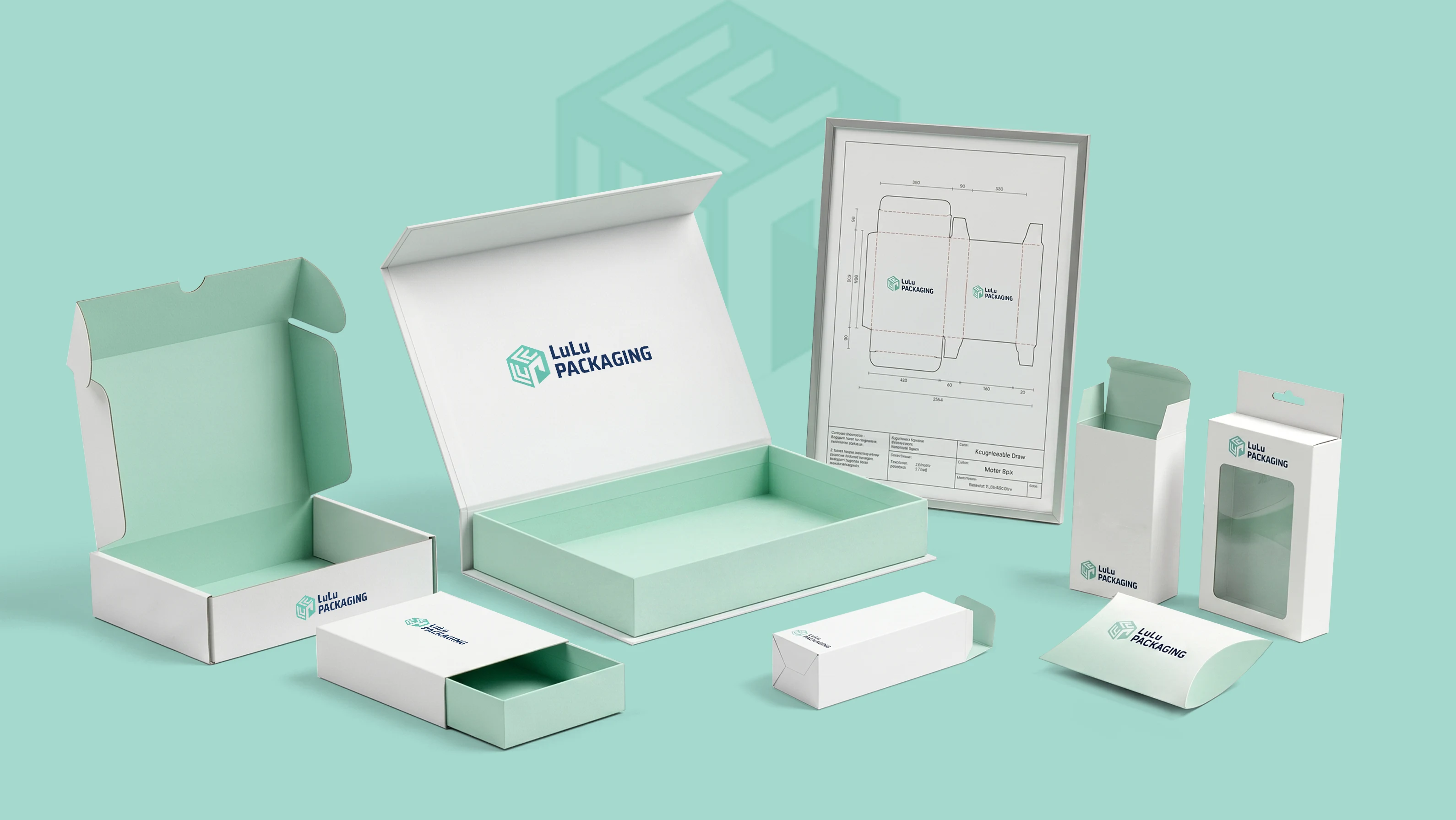
There are more cosmetic box structures than most brands realize. Here's what they are, what they cost, and where they fit.
Folding Cartons
This is the most widely used structure in cosmetic packaging. You've seen it on thousands of products. It's a flat-packed paperboard box assembled during the packing process. Tuck-end closures, straight or angled edges, with or without a window.
Folding cartons are the standard for individual product units like serums, creams, lipstick, mascara, and cleansers. They're lightweight, cost-effective to produce at volume, and take printing beautifully.
Most folding cartons use paperboard in the 300–400 GSM range. Heavier board means a sturdier feel. Thinner board works fine for smaller, lighter products but can feel insubstantial on shelf for a premium-priced item.
Best for individual skincare and cosmetic SKUs, mid-market to premium positioning, brands managing multiple product lines or SKU counts
What to watch. At a premium price point, a standard folding carton can undercut the perceived value of what's inside. If your serum retails above $45, board weight and finish selection matter more than they do for a $12 cleanser.
Rigid Setup Boxes
Rigid boxes, also called setup boxes, are a different category. They're made from thick greyboard, typically 1mm to 3mm, wrapped in printed specialty paper. They don't fold flat. They're solid, heavy, and substantial in the hand.
Think of how a luxury fragrance set arrives, or how an iPhone ships. That's a rigid box. It doesn't collapse or compress. It holds its shape. And before the customer reads a word, it tells them they're holding something worth the price.
Rigid boxes cost more per unit and take more warehouse space. They're not the right structure for every product.
For gift sets, PR kits, limited editions, and hero products at a premium price point, they're often exactly right. A boutique retailer in Chicago tested the same serum formula in three different packaging formats and called their supplier back the same afternoon. They chose the rigid box. Nothing changed but the structure.
Best for gift sets, hero products, PR kits, premium skincare, fragrance, limited editions, retail buyers who need shelf presence
What to watch is higher per-unit cost and larger storage footprint. Budget for it intentionally, not as an afterthought.
Drawer Boxes (Sliding Tray)
A drawer box has an outer sleeve and an inner tray that slides out. The reveal is slower and more interactive than a standard open-top box. It creates an intentional unboxing moment.
Drawer boxes work well for multi-product sets, curated collections, and gift-with-purchase formats. They also photograph well, which matters more than ever. According to Attest's 2026 Gen Z Beauty Trends research, TikTok usage for beauty content has risen to 53% among Gen Z consumers, making social-ready packaging a genuine business consideration, not just an aesthetic one.
Best for curated sets, gifting, subscription boxes, brands where the unboxing moment is part of the brand experience
What to watch is that drawer boxes are more complex to assemble than standard folding cartons, which can affect packing line speed at volume.
Window Boxes
A window box has a die-cut opening covered with a clear film, letting the customer see the product inside without opening the box. Common in lip color, eye shadow, and skincare where the product color or texture is a purchase driver.
They work well at retail where the customer can't handle the product directly. Less relevant for e-commerce where the product is typically shown in detail photography.
Best for retail-first brands where product color or texture is a key purchase trigger (lip, eye, skincare with visible texture)
What to watch is the window film needs to be compatible with your sustainability goals. Most standard window films are not recyclable with the box.
Mailer Boxes
A mailer box is a corrugated or rigid structure designed to ship without an additional outer carton. It's the box the customer receives through the mail. For DTC e-commerce brands, this is often the first physical interaction the customer has with the brand.
The inside of the mailer box is valuable real estate. Think tissue paper, printed interior, a card, a sustainable fill material. This is where the unboxing experience lives.
Best for DTC e-commerce brands, subscription box formats, gifting, brands where delivery experience is a marketing tool
What to watch is that corrugated mailer boxes can look functional and logistics-focused if the interior experience isn't considered alongside the exterior.
Box Structure by Product Type
| Product | Recommended Box Type | Notes |
|---|---|---|
| Serum / Face Oil ($45+) | Rigid setup or premium folding carton (350+ GSM) | Board weight and finish matter at this price point |
| Cleanser / Moisturizer | Folding carton (300–350 GSM) | Cost-effective and takes printing well |
| Lipstick / Lip Gloss | Folding carton or window box | Window useful if shade is a visible purchase driver |
| Eye Shadow Palette | Rigid lid-and-base or folding carton with insert | Depends on price point and channel |
| Gift Set / Collection | Rigid setup or drawer box | Unboxing experience is the product here |
| Fragrance | Rigid setup box | Structural premium expected at any price point |
| E-Commerce Shipping | Mailer box with interior finish | Exterior is functional; interior is the brand moment |
Materials: What Your Box Is Made From Matters More Than It Used To
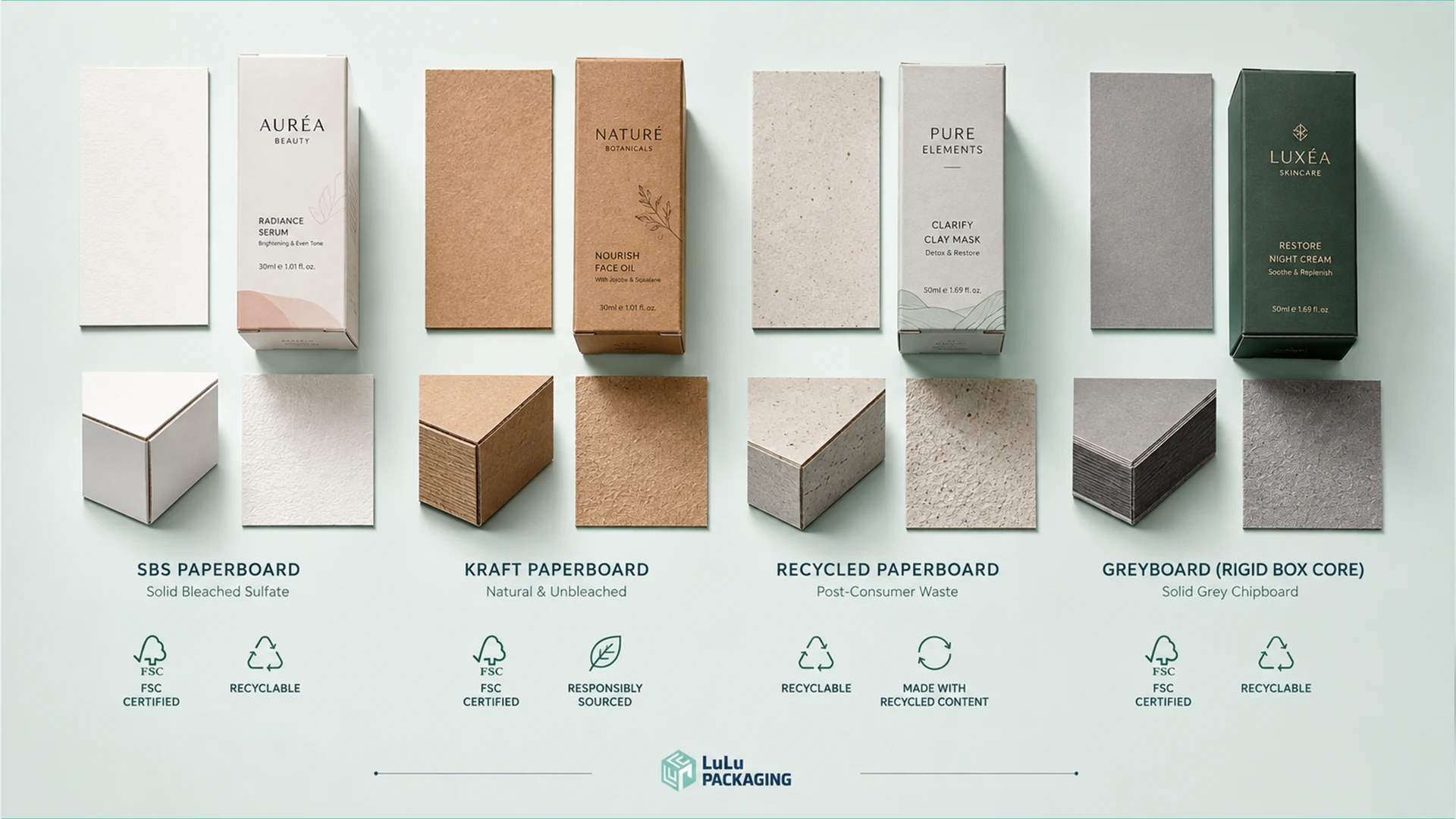
In 2026, the material your box is made from carries information. US beauty consumers read it as part of your sustainability story. Here's what the main options look like in practice.
SBS Paperboard (Solid Bleached Sulfate)
The standard for cosmetic folding cartons. Bright white, smooth surface, takes ink and finish evenly. It's what most stock cosmetic boxes are made from.
If sustainability is part of your brand story, ask your supplier whether FSC-certified SBS is available. It usually is, at a marginal cost difference, and it gives you a certifiable claim rather than a vague one.
Kraft / Uncoated Board
Natural brown, textured surface, lower environmental footprint when made from recycled or FSC-certified fiber. Works particularly well for clean beauty, organic, and botanical positioning. Blind debossing on kraft, with no added ink, has become one of the cleaner aesthetic signals in premium natural beauty packaging.
Recycled Content Board
Made from post-consumer or post-industrial fiber. Certifiable under GRS (Global Recycled Standard) if you need to back the claim. The surface can show slight variation compared to virgin board, so account for this in color-sensitive designs.
Greyboard for Rigid Boxes
The structural core of rigid setup boxes. Heavier weight equals sturdier box. Typical range is 1mm to 3mm. Wrapped in printed specialty paper and finished with whatever coating or foil your brief calls for.
Finishes and Where Brand Personality Lives
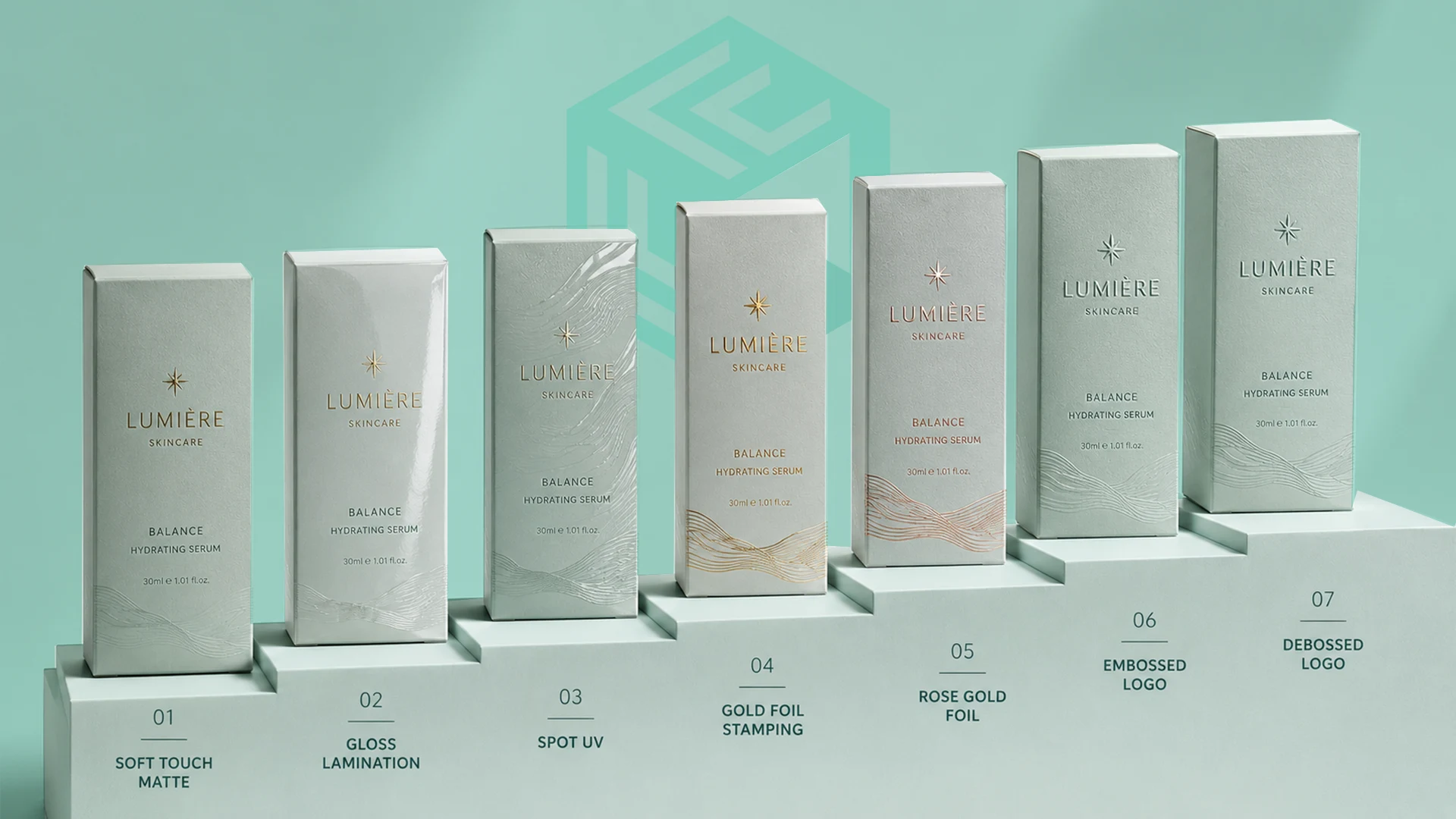
The finish on a cosmetic box isn't decoration. It's communication. Here's what each finish says before the customer reads a word.
- Soft-touch matte lamination creates a velvety surface that feels expensive and resists fingerprints. It's currently the finish most associated with understated luxury in premium beauty. Works especially well with embossed logos.
- Gloss lamination delivers high-impact color and vibrancy. Reads as bold and energetic. Works well for mass-market and color-cosmetic positioning where shelf pop matters more than quiet luxury.
- Spot UV applies a high-gloss coating to specific design elements like a logo, a pattern, or a product name, against a matte background. The contrast draws the eye and creates a premium tactile effect at a lower cost than foil.
- Hot foil stamping applies metallic foil under heat and pressure. Gold, silver, rose gold, copper, holographic. Each combination signals a different brand personality. Rose gold on white or blush has defined premium skincare for the past several years and remains one of the most requested combinations we see. Black foil on black soft-touch creates something different. It's a tone-on-tone effect that only reveals itself as the viewing angle changes.
- Embossing and debossing add dimension that photography cannot fully capture. Embossed logos feel refined in hand. Debossed logos press inward and look cleaner on organic or minimal packaging. Both add a tactile layer that differentiates your box from anything printed flat.
A practical note for brands earlier in their volume curve. Silk screen printing with a single foil-stamp accent often delivers the best quality-to-cost ratio at runs under 5,000 units. The more complex combinations like foil plus soft-touch plus emboss make more economic sense as volume scales.
MOQs and Lead Times to Plan For in the USA
This is where a lot of first-time buyers get surprised. Let's be direct about what's realistic.
- Minimum order quantities for custom cosmetic boxes typically start at 500–1,000 units for folding cartons and 500 units for rigid boxes with standard finishes. Lower minimums are available with some suppliers, some as low as 50 units using digital printing, but per-unit cost increases significantly at that range.
- Lead times after sample approval typically run 4–8 weeks for standard custom production. Rigid boxes and complex finishing can add time. Rush production is available from some US-based suppliers but carries a cost premium.
- Dieline approval comes before production. Your artwork is applied to the box's flat dieline, which is the unfolded template. Approving this stage carefully before production begins avoids costly corrections later. Ask for a physical sample before approving the full run.
- Tooling and plate charges apply on first orders for most custom structures. These are one-time costs. They don't recur on reorders of the same structure. Budget for them as a startup cost, not an ongoing one.
- US-based suppliers typically offer shorter lead times and easier quality control access than overseas production. For brands building inventory on a launch timeline or managing multiple SKU releases in a year, that proximity has real operational value.
The Decision Framework for Matching Box to Brand
Here's how to think through the right choice for your product line.
Step 1
Fix your price point first. Your retail price drives the packaging specification more than almost anything else. A product retailing at $90 needs a box that supports a $90 purchase decision. A product at $18 needs a box that's sharp and professional without overcapitalizing.
Step 2
Know your primary channel. Retail and e-commerce have different requirements. Retail needs shelf presence, face-out display, and durability under handling. E-commerce needs shipping protection, interior experience, and photography performance.
Step 3
Be honest about your sustainability story. If sustainability is central to your brand, your box material needs to back the claim. FSC-certified board, recycled content, or kraft with a certifiable sustainability credential gives you something real to say. A generic "eco-friendly" label without certification is a liability, not an asset.
Step 4
Get samples before you commit. Reading about a finish is useful. Holding it in your hand is a different experience. Request samples from your supplier before approving any run. Weight, texture, how the lid moves. These are things you need to feel, not see in a photo.
Step 5
Think beyond the first SKU. If you're planning to launch a product line, your box structure and design system should accommodate future SKUs without a complete redesign. Talk to your supplier early about scalability. A good partner will factor this into the structural recommendation.
Frequently Asked Questions
What is the most important factor when choosing a cosmetic box?
Your retail price point and sales channel should drive the decision. A premium price point requires packaging that supports perceived value. A DTC e-commerce launch requires packaging that performs on delivery. Start there, then work backward to structure, material, and finish.
What's the difference between a folding carton and a rigid box?
A folding carton is a flat-packed paperboard box assembled during packing. It's the industry standard for individual cosmetic units. A rigid setup box is a thick greyboard structure that doesn't fold, holds its shape, and communicates premium positioning before the customer opens it. The right choice depends on your price point and channel.
How much does a custom cosmetic box cost in the USA?
Costs vary significantly by structure, material, finish, and volume. At 1,000 units, a custom folding carton with standard printing typically runs between $0.50 and $2.00 per unit. Rigid boxes start higher, often $3.00 to $8.00 per unit at similar volumes, with per-unit cost dropping as volume increases. We're happy to provide a specific quote based on your product dimensions and brief.
Can I get sustainable custom cosmetic boxes without sacrificing print quality?
Yes, FSC-certified board and recycled content paperboard both accept high-quality printing, foil stamping, and specialty finishes. The surface consistency of recycled board can vary slightly in color-critical designs, but premium results are achievable on eco-friendly stock across most applications.
What's a realistic timeline for custom cosmetic packaging in the USA?
Plan for 10–12 weeks from initial brief to delivery for a first order. That includes dieline development, sample approval, production, and shipping. Rush options can compress this, but building enough lead time into your launch planning avoids that cost and the stress that comes with it.
Do I need to commit to a full run before seeing a sample?
No, Any reputable supplier will provide a physical sample or pre-production proof before you approve a full run. If a supplier resists this step, treat it as a red flag. Samples protect you and give you the chance to catch anything that needs adjusting before it's produced at scale.
What to Do Next
If you've made it through this guide, you have what you need to walk into a supplier conversation with confidence. You know what structure fits your product. You know what your finish should communicate. You know what questions to ask before you commit.
The next step is getting samples in your hands.
We work with US cosmetic and beauty brands on custom box solutions, from first launches to full product line builds. We offer sample kits so you can see and feel the materials and finishes before placing a single order.
Or reach out directly with your product specs and we'll come back with a recommendation the same business day.
Related Guides
Need Custom Packaging?
Our packaging specialists are here to design the perfect solution for your brand. Get a tailored free quote today.